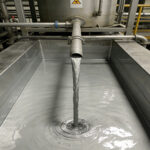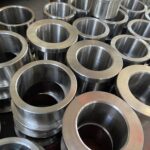

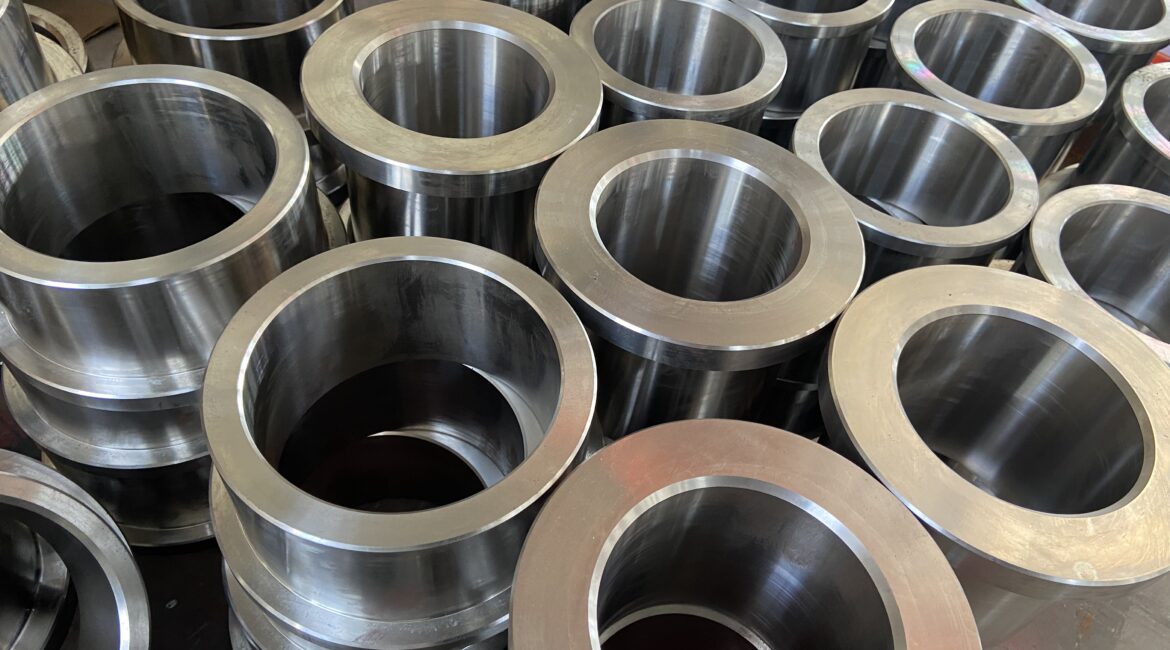
In hot-dip galvanizing production lines, the zinc pot bushings and stabilizing roller bearings are core components that withstand the most demanding operating conditions. They are continuously immersed in molten zinc at temperatures exceeding 460°C and subjected to mechanical wear. This commonly leads to short service life, frequent replacements, roller system vibration, and defects in the galvanized sheet quality – significant problems in the industry. This article will delve into the failure mechanisms of hot-dip galvanizing bushings and bearings, explaining why they fail rapidly under the combined effects of corrosion and wear, and providing professional technical solutions to extend their lifespan.
Extreme Operating Conditions: Understanding the Starting Point of Failure – Corrosion and Wear in High-Temperature Molten Zinc
The working environment of hot-dip galvanized bushings and bearings is a typical “double hell.” Corrosion by molten zinc is the primary challenge: molten zinc is highly chemically reactive and permeable, capable of penetrating the material’s micropores. Simultaneously, under limited lubrication conditions, continuous mechanical wear occurs between the components. These two destructive processes are not independent but mutually reinforcing and synergistic, ultimately leading to changes in component dimensions, failure of the fit, and severe vibration of the entire roller system.
In-depth analysis: The synergistic failure mechanisms of bushings and bearings
Analysis of the failure process of hot-dip galvanized bushings
The bushings typically use a WC-based wear-resistant coating, and their failure is a chain reaction process:
Step 1: Preferential corrosion of the binder phase. The metallic binder phase in the coating (such as Co or Fe-Ni phase) is a weak point in terms of resistance to molten zinc corrosion. The molten zinc penetrates through the pores in the coating, corroding the binder phase and causing the hard WC particles to lose their support.
Step 2: The coating structure collapses. The WC particles, having lost their bonding, become loose and detach due to erosion by the molten zinc and mechanical friction.
Step 3: The combined wear modes exacerbate the damage. The detached particles act as abrasives, causing abrasive wear; localized high temperature and pressure lead to adhesive wear; and alternating stress induces fatigue wear. The ultimate result is a continuous reduction in the outer diameter of the bushing.
Analysis of the failure process of hot-dip galvanized bearing shells
Bearing bushings often utilize ZrO2/Al2O3 composite ceramics, and their failure modes differ from those of metal coatings:
- Crack initiation and propagation: The inherent micropores and grain boundaries in the ceramic act as channels for zinc liquid penetration. Under the combined action of thermal stress and mechanical tensile stress, microcracks initiate and propagate.
- Brittle spalling and particle detachment: The extension of cracks leads to brittle spalling of the material, and surface ceramic particles detach directly under load, forming numerous pits, causing the inner diameter of the bearing bush to gradually increase.
A vicious cycle of synergistic effects
The key issue is that the failure of the bushing and the bearing are mutually reinforcing: ceramic particles detached from the bearing exacerbate the wear of the bushing; conversely, WC particles detached from the bushing and the resulting zinc slag accelerate the surface damage of the bearing. Corrosion creates conditions for wear, and wear exposes new surfaces, accelerating corrosion, forming a vicious cycle that is difficult to break. This is the fundamental reason for the short lifespan of zinc pot components.
How to address this? Breakthrough ideas for extending the lifespan of bushings and bearings
To break this vicious cycle of failure, a systematic upgrade is necessary, both in terms of material systems and protection concepts:
Optimizing bushing coating technology:
- Developing highly corrosion-resistant bonding phases: Using Ni-based alloys or special Fe-based alloys that are more stable in molten zinc, instead of traditional Co-based or ordinary Fe-Ni phases.
- Improving coating density: Advanced processes such as high-velocity oxy-fuel (HVOF) spraying are used to reduce coating porosity and prevent zinc liquid penetration.
- Design functional gradient coatings: to make the coating surface more corrosion resistant and the underlying layer more adhesive.
Enhancing the toughness of ceramic bearings:
- Phase transformation toughened ceramics are used, such as Y2O3 to stabilize ZrO2, and its phase transformation effect is used to consume crack energy and improve impact resistance.
- Precision surface machining: Reduces surface roughness and decreases the sources of microcrack initiation.
System maintenance and monitoring recommendations:
- Regularly monitor the aluminum content in the zinc bath to maintain a composition range that helps form the protective Fe-Al-Zn phase.
- Establish a predictive maintenance system for vibration and wear of key components to intervene in advance and avoid unplanned downtime.
Conclusion: From Understanding Failure to Proactive Protection
The failure of hot-dip galvanized bushings and bearings is essentially a problem of synergistic failure of materials under extreme multi-field coupling. The solution lies not in pursuing a single performance indicator, but in the systematic design of new material systems that can resist the “corrosion-wear synergistic attack.” By deeply analyzing the failure mechanism and making targeted improvements in material selection, process optimization, and maintenance strategies, it is expected that component life can be significantly improved, ensuring the stable, efficient, and high-quality operation of the hot-dip galvanizing production line.