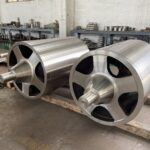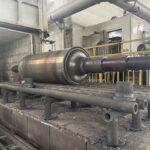

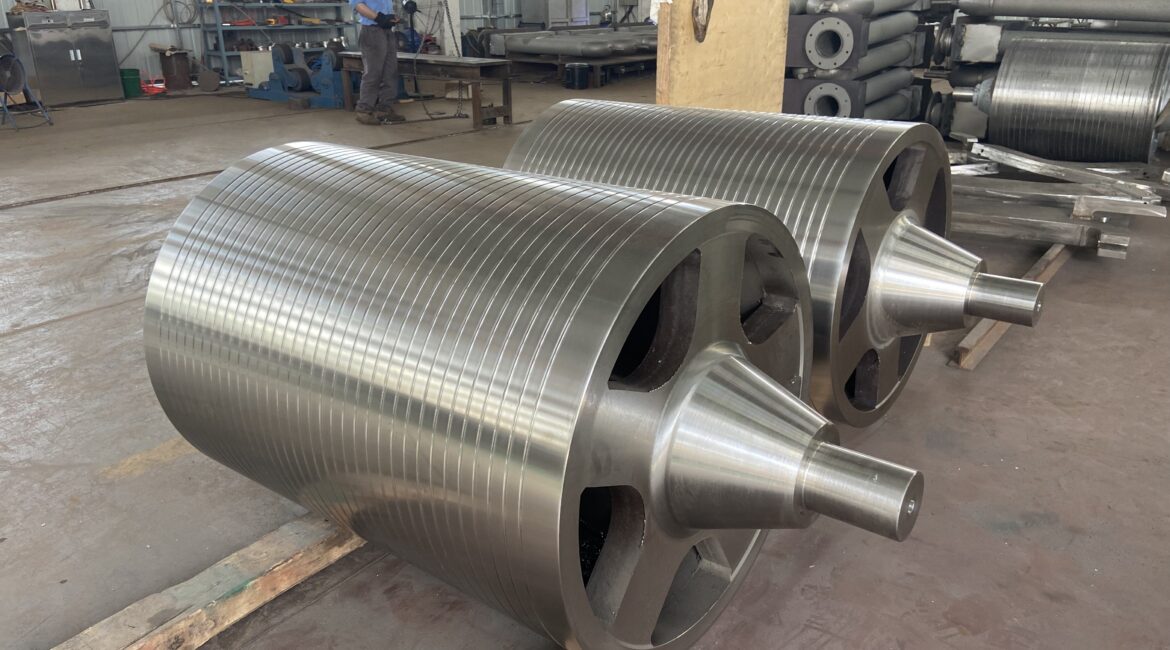
In the core section of the hot-dip galvanizing production line, the sink roll, as a key component completely immersed in the molten zinc, plays a role far beyond simply guiding the steel strip. Its working principle, especially its precise positioning in three-dimensional space, is a core technology that determines the uniformity of the steel strip coating and the final product quality. Understanding how the sink roll works and how it controls the zinc flow field is fundamental to solving galvanizing defects and improving process efficiency.
The core function and working principle of the sink roll in a galvanizing line
In a high-temperature zinc bath, the sink roll acts as the “stabilizing force” within the zinc pot roller system, primarily performing three main functions:
① Steering function: Guides the steel strip to be vertically immersed into and withdrawn from the molten zinc bath, completing the core process of the hot-dip galvanizing process.
② Stabilization function: Tension is applied to the steel strip in the zinc bath to suppress vibration and floating, ensuring stable operation of the steel strip.
③ Core control function: Controlling the flow state and adhesion pressure of the zinc liquid on the steel strip surface is the fundamental physical factor affecting coating uniformity.
Key to Coating Uniformity: A Detailed Explanation of the Four Positioning Dimensions of the Sink Roll
The uniformity of the coating mainly depends on the amount of zinc liquid adhering to the steel strip surface and the stability of the reflux dynamics when the strip is withdrawn. The precise positioning of the sink roll has a decisive influence on this.
Horizontal position and distance from the air knife: These determine the stability of the zinc liquid flow
The area between the top of the sink roll and the air knife is called the “zinc bath recirculation zone.” Precise setting of its horizontal position is crucial:
- Distance optimization: If the distance is too great, the molten zinc will flow back excessively due to gravity, resulting in a thicker coating on the lower part of the steel strip; if the distance is too short, there will be insufficient space for the molten zinc to flow back, easily leading to scratches.
- Angle control: Even a small deviation in the installation angle can lead to unequal distances between the strip edges and the air knife, resulting in uneven coating thickness across the strip (one side thicker than the other).
Immersion depth and contact angle: affecting coating edge thickness and alloying
The immersion depth of the submerged roller determines the wrap angle and path length of the steel strip in the molten zinc.
- Depth Standard: Sufficient depth ensures that the steel strip is fully immersed and heated evenly, facilitating the formation of a good Fe-Zn alloy layer.
- Consequences of insufficient immersion depth: This can easily lead to the strip edges “prematurely” separating from the zinc bath, resulting in defects such as thinner zinc coating at the edges.
Levelness and perpendicularity: the lifeline for ensuring the lateral uniformity of the plating layer
- Levelness: The roller body must be perfectly level. Any tilt will lead to uneven tension on both sides of the steel strip, causing it to deviate from its path and resulting in a thinner coating on one side and a thicker coating on the other.
- Perpendicularity: It must be strictly parallel to the stabilizing roller above. Lack of parallelism will lead to uneven compression of the steel strip in the width direction and disrupt the zinc bath flow field.
Surface condition synchronized with rotational speed: prevents periodic defects
- Surface condition: Using hard coatings such as tungsten carbide and maintaining a smooth surface minimizes dross formation (slag buildup). Dross buildup periodically disrupts the zinc flow field, resulting in regular longitudinal zinc streaks (zinc ripples).
- Rotational speed synchronization: The passively rotating sink roll must be synchronized with the strip speed; slippage will scratch the coating or disrupt the flow field.
How do modern galvanizing lines achieve intelligent and precise control of sink roll
Modern high-precision galvanizing lines achieve intelligent control through technological integration:
① Precision mechanical design: Utilizing a heavy-duty, deformation-resistant structure, combined with high-precision ball screws or hydraulic mechanisms, to achieve three-dimensional micron-level online adjustment.
② Online monitoring and closed-loop control:
- Coating thickness gauge provides real-time feedback: It scans the transverse coating thickness of the steel strip, and the data is fed back to the control system.
- Intelligent linked adjustment: When lateral unevenness is detected, the system can automatically adjust or prompt the operator to fine-tune the height of one end of the sink roll to achieve precise correction.
③ Coordinated Control System: The sink roll, stabilizing roller, and air knife form a coordinated control unit, enabling overall process optimization through the automatic adjustment system of the sink roll.
Troubleshooting common plating defects and their correlation with sink roll positioning problems
| Defect phenomena | Possible issues related to the positioning of the sink roll | Initial investigation directions |
| Uneven thickness in the lateral direction (C-shaped/wedge-shaped) | Poor levelness; the immersion depth is uneven at both ends | Check the level gauge readings on the roller body and verify the immersion depth at both ends |
| Longitudinal strip-like zinc undulations (zinc scars) | Severe buildup on the roller surface, or poor dynamic balance of the roller | Shut down the machine to inspect the roller surface and clean off any buildup; check the condition of the bearings and the roller body |
| The plating on the edges is continuously thinner than desired | Insufficient overall immersion depth, or strip misalignment | Measure and adjust the immersion depth; check the alignment of the stabilizing rollers |
| Periodic scratches or bright spots | Roller surface damage or asynchronous rotation speeds can cause slippage | Check the integrity of the roller surface and confirm the synchronization of the drive system |
The sink roll is by no means a passive steering device, but rather a core regulator of the physicochemical processes within the zinc pot. Every dimension—horizontal, vertical, depth, and parallelism—acts like a precision knob, controlling the flow and adhesion of the molten zinc on the steel strip surface. Modern high-end galvanizing lines achieve intelligent and precise positioning of the sink roll through digital, quantifiable, and feedback-based control, ultimately ensuring high-quality galvanized products with extremely uniform coatings and smooth surfaces. Therefore, a deep understanding and precise control of the sink roll’s working principle is a core indicator of the level of galvanizing technology.